Global markets breathed a massive sigh of relief on Wednesday following a sudden, conditional two-week ceasefire between the United States and Iran—a breakthrough designed to reopen the heavily contested Strait of Hormuz.
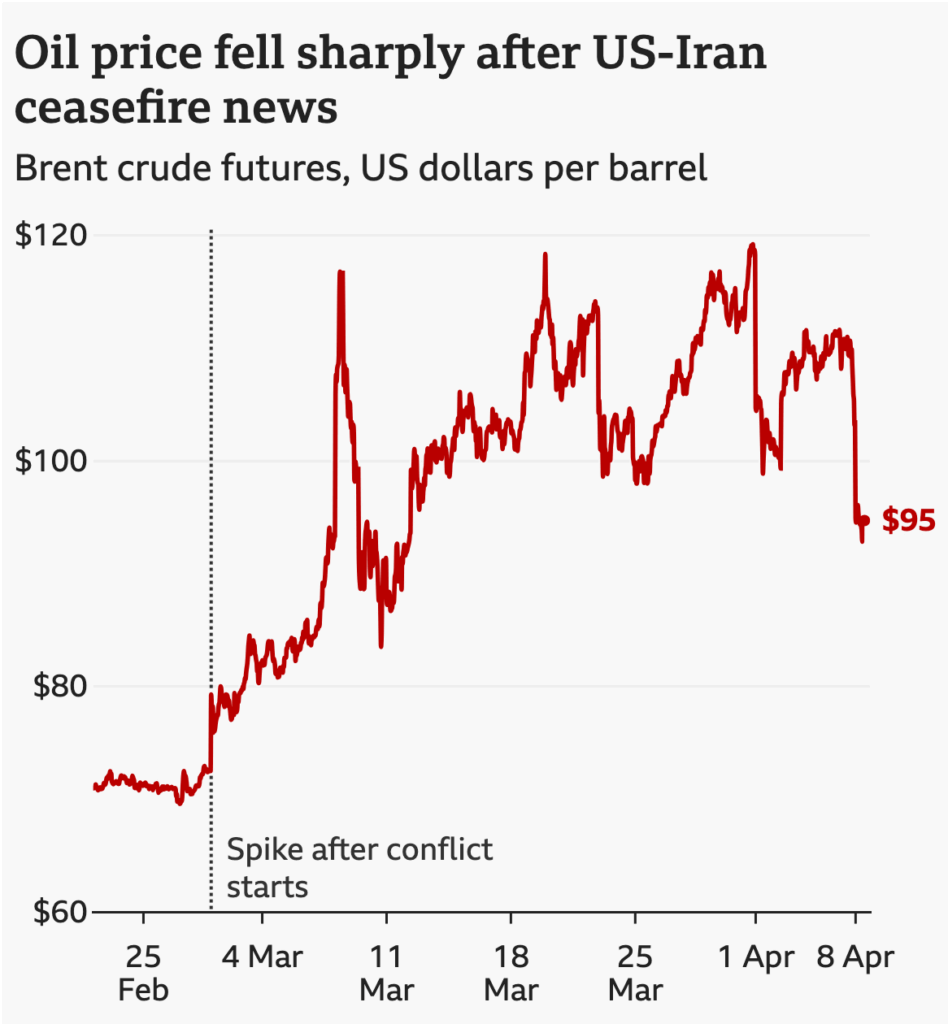
The immediate economic impact was drastic. Benchmark Brent crude shed roughly 13% of its value, sliding to $94.80 a barrel, while US-traded crude plummeted over 15% to $95.75.
While the drop offers immediate relief to global supply chains, energy costs remain painfully high compared to the $70-a-barrel baseline seen before the conflict erupted on February 28. The spike was driven by severe disruptions in Middle Eastern oil and gas supplies after Iran threatened to choke off the vital waterway in retaliation for US and Israeli airstrikes.
Markets Rally on the News
The optimism on the energy front immediately spilled over into global equities.
Asia led the charge:
- South Korea’s Kospi: + ~6%
- Japan’s Nikkei 225: + 5%
- Hong Kong’s Hang Seng: + 2.8%
- Australia’s ASX 200: + 2.7%
European markets rode the wave at the opening bell, with Germany’s DAX climbing nearly 5%, France’s CAC gaining 4%, and London’s FTSE 100 adding 2.53%. US stock market futures are also flashing green, signaling a strong open for Wall Street.
The Midnight Deal
The diplomatic breakthrough came late Tuesday evening. President Donald Trump took to social media to announce the pause, stepping back from a severe ultimatum set for 8:00 p.m. EDT where he warned that “a whole civilisation will die tonight” without an agreement.
“I agree to suspend the bombing and attack of Iran for a period of two weeks… subject to the Islamic Republic of Iran agreeing to the COMPLETE, IMMEDIATE, and SAFE OPENING of the Strait of Hormuz,” Trump wrote.
Iranian Foreign Minister Abbas Araghchi matched the rhetoric online, confirming Tehran would agree to the ceasefire “if attacks against Iran are halted,” and adding that safe passage through the strait “will be possible.”
According to Xavier Smith, a research director at AlphaSense, domestic pressures likely played a role in Washington’s willingness to pause hostilities. Pushing the conflict further risked a “self-inflicted economic wound” via skyrocketing energy prices, a dangerous gamble given the looming pressure of approval ratings on Trump’s leadership.
A Long Road to Recovery
The immediate perk of the ceasefire is that heavily backlogged oil tankers stranded near the strait can finally move. While a handful of vessels—including fleets from China, Japan, the Philippines, and a French-owned, Malta-flagged container ship—managed to negotiate safe passage during the fighting, traffic has been a fraction of its normal volume.
But fixing the broader energy supply chain won’t happen overnight.
Saul Kavonic, an analyst at MST Marquee, cautioned that a full resumption of Middle Eastern energy output requires absolute confidence in a permanent peace deal. Even then, the physical damage to the region is staggering.
Iranian retaliatory strikes on regional oil-rich infrastructure could take years—and upwards of $25 billion—to repair, according to data from research firm Rystad Energy.
A prime example is the mid-March assault on Qatar’s Ras Laffan industrial hub, which accounts for about 20% of global liquefied natural gas (LNG). Operators reported that the strikes knocked out 17% of the country’s export capacity, a massive infrastructure gap that could take up to five years to fully restore.
Asia Bears the Brunt
The economic fallout has battered Asia, where many nations lack deep strategic reserves or their own refineries and rely heavily on Gulf energy.
Regional airlines have been forced to hike fares and slash routes as jet fuel costs soared. Just two weeks ago, the Philippines—which imports 98% of its oil from the Middle East—made the drastic move of declaring a national energy emergency after pump prices more than doubled.
“The ceasefire is good news for Asian countries,” noted Ichiro Kutani of Japan’s Institute of Energy Economics. “If it holds, oil prices will return to normal states, though this will take time.”
